
Bone Density Test (DEXA Scan)
A simple, painless scan to measure bone strength — what to expect and what the results mean
What is a DEXA Scan?
A DEXA (Dual-Energy X-ray Absorptiometry) scan is a quick, painless test used to measure your bone mineral density (BMD). It helps identify osteopenia (reduced bone density) or osteoporosis (significantly reduced bone density) before a fracture occurs.
The scan uses very low-dose X-rays — the radiation exposure is minimal, roughly equivalent to a few hours of natural background radiation.
🦴 Why is bone density important for women?
Bone density declines more rapidly in women during and after menopause due to falling oestrogen levels. Regular DEXA scanning helps monitor this and guides decisions about MHT, calcium, vitamin D, and other treatments to protect your bones.
Main Areas Measured
Lumbar Spine
Lower vertebrae (L1–L4). One of the first areas where bone loss occurs.
Total Hip
Overall bone density of the hip joint, which is the most significant fracture risk site.
Femoral Neck
The narrowest part of the thigh bone just below the hip — a key site for fracture assessment.
What Happens During the Scan?
You lie on a padded table — no enclosed tunnel or claustrophobic machine.
The scanner arm passes slowly over your spine and hip.
The procedure takes 10–30 minutes and requires no injections or special preparation.
You remain fully clothed (no metal objects such as belts or underwire bras).
You do not need to fast beforehand.
📋 Before your scan
Avoid taking calcium supplements for 24 hours before the scan, as high calcium can temporarily affect readings. Wear comfortable, loose-fitting clothing with no metal zips or fastenings.
Understanding Your Results – T-Score
Your results are reported as a T-score, which compares your bone density to that of a healthy 30-year-old woman (the peak bone mass reference).
| T-Score | Interpretation | What It Means |
|---|---|---|
| −1.0 and above | Normal bone density | Bone strength is within the healthy range |
| −1.1 to −2.4 | Osteopenia | Below-average bone density; monitoring and lifestyle changes recommended |
| −2.5 and below | Osteoporosis | Significantly reduced bone density; treatment likely recommended |
What Happens After the Scan?
Your results will be sent to your doctor at Arami Women's Health, who will discuss them with you and recommend any necessary action. Depending on your T-score and other risk factors, this may include:
Lifestyle changes (increased calcium, vitamin D, weight-bearing exercise)
Starting or continuing menopausal hormone therapy (MHT)
Bone-strengthening medications (e.g., bisphosphonates)
A follow-up scan in 1–2 years to monitor changes
Reference Graphic
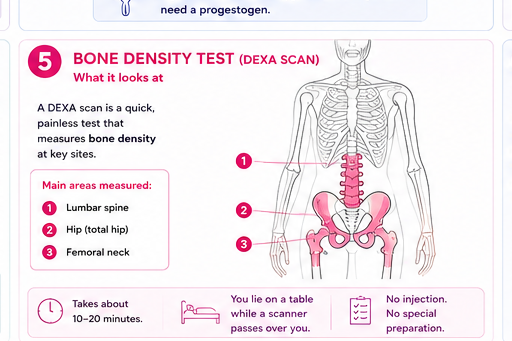
DEXA scan areas — lumbar spine, total hip, and femoral neck — see panel 5 of the Arami resource guide
Due for a bone density check?
Ask us about arranging a DEXA scan referral and what your results mean for your health.
Medical Disclaimer
This information is general in nature and does not replace professional medical advice. T-score interpretation should always be done in the context of your overall health, fracture history, and individual risk factors by a qualified healthcare provider.